

Self-care is something I CONSTANTLY advocate for. You can ask my friends, colleagues, and even students (I am a teacher b.t.w). I am always saying things like ‘You can’t pour from an empty cup’ or ‘Do not forget about yourself’.
In class, when I ask my students what they did over the weekend I usually get responses such as ‘doing assignments’ or ‘catching up on school work’ and I immediately respond with, What about you? What about family?
The thing is, yes I advocate for self-care but what does that actually mean?
I am currently reading a book titled “How to Stop Feeling Like Sh*t” by Andrea Owen and in one of her chapters she speaks about numbing versus comfort and it really put things into perspective for me.
She said, “Many of the things we tend to use as numbing mechanisms are the same things that we use to comfort ourselves, but when we chuck self-control out the window, we move into disassociating territory”.
She goes on to give this example, “Had a bad day and hopped onto Facebook to forget about it for a few minutes? a month later, you realize you’ve spent more time scrolling through Facebook than you have interacting with actual people in real life.”
WOW… Just wow!

Let us unpack this real quick.
Self-sabotage according to www.verywellmind.com has been explained as such, “self-sabotaging behaviour refers to intentional action (or inaction) that undermines people’s progress and prevents them from accomplishing their goals. Self-sabotage occurs when people hinder their own success.”
Now I am not sure which category you fall into, is it intentional or are you simply not achieving your goals due to inaction? Regardless you are still hindering aspects of your life with the choices you are making. Scratch that. That WE are.
I am definitely not sitting on a pedestal watching you fail. I to self-sabotage. Apparently, more than I realised. ((sigh))
HOW TO STOP SELF-SABOTAGING:
I am not going to give a full-blown teaching on self-sabotage because it’s quite an in-depth topic. The website I linked above has got some great resources. What I want to do is help with the first step, and that is admitting you we have a problem, only then can something be done about it.
So we need to ask ourselves just TWO questions to help us unpack this whole self-sabotaging thing.
- Is your behaviour aligning with your goals?
- Is your intentional action or inaction based on a fear of failure and worry about looking foolish?
Simple questions right?? ((insert face palm emoji here))
Think about these questions, but really think about it. And before you say, “I am tired”, or “I am always so busy”, stop right there. Once you want something bad enough those excuses do not hold the same weight as it does when you are sitting on the self-sabotage couch watching your life pass by you.

Again let me remind you, I am not sitting on a pedestal. I am currently on the self-sabotage couch… But, now that I am aware of my problem and am doing some introspection I am slowly getting off this couch that hinders my progress and cleaning the space around it. (Just remember, the self-sabotage couch is a metaphor but if you literally spend your days on the couch (like me) then it’s pretty literal too.)
After getting a better understanding of self-sabotage I looked a little deeper at what self-care means and I was quite surprised because it is not something people usually search for, it is something people do. We all tell one another that self-care is doing something for yourself to make you happy. It is that simple right? ((insert eye-rolling emoji here))
According to the same site, I read another article, www.verywellmind.com and they defined self-care as such, “Essentially, self-care means a conscious act people take in order to promote their own physical, mental, and emotional health.”
Read that again. What sticks out?
A CONSCIOUS ACT
Would you say that the things you generally do for “self-care” you do consciously? Because despite my going on and on to anyone who will listen about the importance of self-care, after reading that chapter in Andrea Owen’s book and diving into what self-care really is about I really started doing some introspection I have come to realise, that I, in fact, do not do it consciously, there is no self-control and it often does feel very disassociative. So am I really caring for myself or am I sabotaging myself to numb the feelings I do not want to feel?
Perhaps you need to ask yourself the same question honestly.
HOW TO DO SELF-CARE PROPERLY:
Alright, now that we have a better understanding of what self-sabotaging and self-care are, we can conclude that we probably self-sabotage a lot and our self-care ‘routine’ isn’t actually promoting our physical, mental, or emotional health.
But how do we fix this?
Well if you have read this far you probably have already admitted it and you have started thinking about examples in your life where you sit on the self-sabotage couch claiming to be caring for yourself and well, you weren’t. You may even be there right now ((like meeeeeeee)). So let us look at 2 things we can start to consciously take care of ourselves so we can actually start to live our best life.
1. Make a list (on your phone or on a piece of paper) of the 6 categories of self-care listed below.
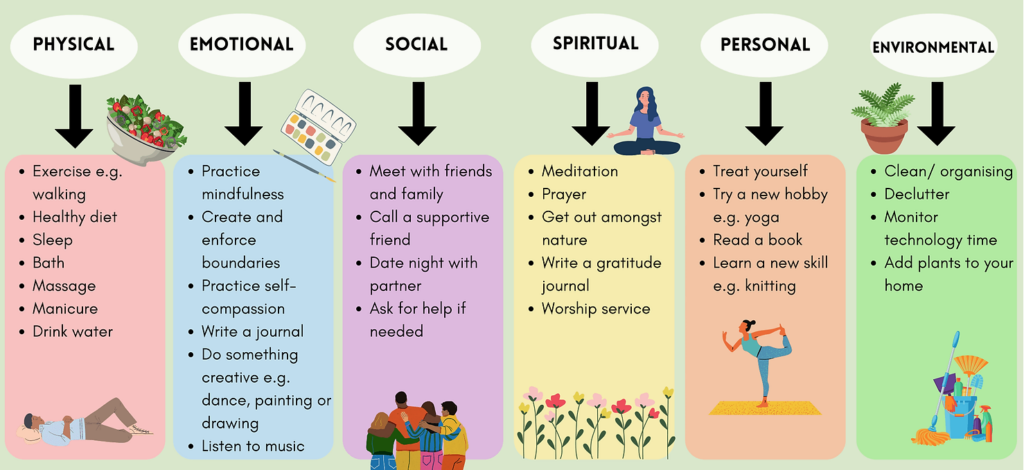
www.headofthehive.co.uk
Once you have done this write down ONE activity that you have done in the past that makes you feel like you’ve breathed in fresh air and the world has calmed around you. Activities that need to be done with intention and consciously.
2. Slowly start doing some of these activities that you listed BUT with intention so that you can feel the full benefit of them. Some of these things overlap, for example, you could exercise (physical) with a friend (social) or clean space in your home (environmental) so that you can try a new hobby (personal).
Try doing at least one thing a day where you actively spend some time refuelling. Even if it is 5 – 10 minutes.
Remember, you might feel like you are managing and getting through the long to-do list you have every day and you do not feel like you are burning out but ask yourself how often you sit on that self-sabotage couch and watch your life pass by you. Once you start implementing these self-care activities and do them with intention and consciously you will enjoy the feeling of breathing fresh air so much that you will begin to make time for it and eventually you cannot imagine your days without it.
*P.S* When I refer to your ‘self-sabotage’ couch I do not mean that you cannot sit and relax on the couch and watch a movie, but remember what Andrea Owen said in her book, “When we chuck self-control out the window, we move into disassociating territory” so if you want to watch a movie, watch a movie but put your phone away and intentionally watch it if you want to watch series? That’s fine, but perhaps stop watching a season a day. ((uhm, yeah I am talking about myself here))
You just need to ask yourself if you are doing it intentionally and if you still have self-control. If the answer is yes then do the things that bring you joy and fill your cup.
I pray reading this has helped you, even just a little bit. Continue to learn and grow. I do not want you to just survive life, I want you to thrive!
God Bless!


2 Comments
This is really helpful and inspiring. Thank you for sharing this personal experience. I hope as time goes on, you yourself can get off your self sabotage couch just I am trying to do myself. Thank you!!